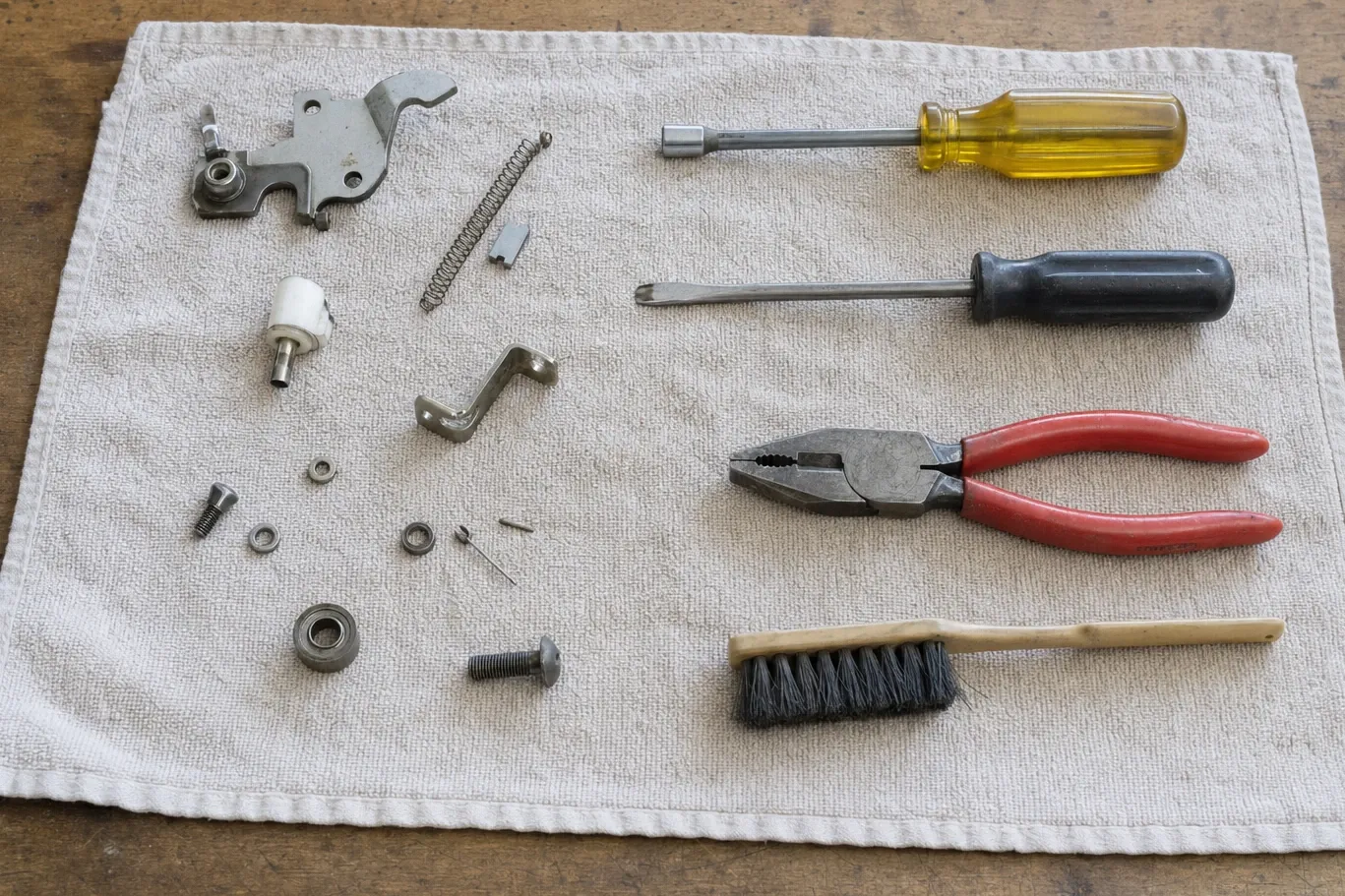
Viking Burner Replacement: Fix the Part or Replace the Range?
Viking burner replacement is almost always a parts job: a bad igniter, cap, base or burner gets swapped on its own, typically for $190–$430, while a new range only makes sense when several systems fail together.

Most Viking burner trouble ends with one part changed, not a new range. A cracked burner base, a warped cap, a fouled igniter or a tired spark module can each be replaced by itself, and that kind of job typically lands between $190–$430 once the fault is confirmed. Swapping out a professional range is a much bigger project, so it pays to know which symptoms point to a simple part and which suggest the whole appliance is wearing out. Phoenix kitchens add one wrinkle of their own: our very hard tap water leaves a chalky white crust wherever a pot boils over, and that crust tends to settle right where the spark needs to jump.
Start with what the burner is actually doing
The symptom tells you which part is involved, and that narrows the decision quickly.
- No clicking at all. On most gas ranges, turning any knob makes every igniter spark at once, so total silence usually means power rather than burners. For a silent 5 Series, Viking’s manual advises shutting the knob first, then checking the power cord and looking at the panel for a tripped breaker or blown fuse.
- Clicking but no flame. The spark is there, but gas is not reaching it, or the spark is landing in the wrong spot. An off-center cap, clogged ports or a mineral-coated electrode are the usual culprits.
- Clicking that keeps going after the burner lights. Moisture or grime around the igniter, or a failing switch behind the knob, keeps the circuit asking for spark.
- Weak, lopsided or yellow flame. Blocked ports, a cap seated crooked, or a gas supply that does not match how the range was set up.
A 5 Series range offers a useful clue here. Its surface burners are designed to spark back to life on their own whenever a flame dies with the valve still open. Should that automatic clicking repeat again and again during ordinary cooking, the burner keeps losing its flame, and the cap, the ports or the gas pressure deserves a closer look.
Check the simple things before ordering anything
Before this becomes a replacement question, try the steps a homeowner can safely do with the burners cold:
- Lift off the grate and cap, then look for food or white scale in the ports. Clear them with a stiff nylon brush or a straightened paper clip, never a wooden toothpick that can snap off inside.
- Dry everything thoroughly. An igniter that got soaked during a spill or a wipe-down will often click without lighting until it dries out.
- Set the cap back so it sits flat and centered. A cap that rocks even slightly can starve one side of the flame.
- Try a neighboring burner. If one fails and the rest light normally, the fault belongs to that single burner.
Anything touching the gas line, the valves or a change between natural gas and propane is not homeowner work. Viking notes that converting a 5 Series to LP uses kit LPKPDR01 and should be handled by a qualified installer or technician.
Four questions that settle repair or replace
How old is the range?
Viking hides the build date inside the serial number: its first six digits give the month, day and year of manufacture. Viking’s own example, 082421C10019872, belongs to a range made on August 24, 2021. On 7 Series ranges you can read that label by opening the oven door and looking up beneath the control panel. Age matters because it decides who pays. Viking’s indoor warranty gives full coverage for two years from purchase, or from closing on a new-construction home if that runs longer. In years three through five, Viking still covers the part itself for gas burners while the owner pays labor and shipping, but ignition systems, bases and caps fall outside that extended coverage.
Which part has failed?
A burner, cap, base or igniter is a contained repair. These pieces are meant to be swapped individually, and doing so brings the cooktop back to full strength. On a 5 Series, that means each sealed burner returns to its rated 15,000 BTU on natural gas, or 12,500 BTU on LP. The picture shifts when the failing piece serves the whole appliance, such as the gas valves behind the knobs or the oven’s ignition, because those jobs cost more and opening the range sometimes reveals other wear.
How often has it failed?
One igniter in many years of cooking is ordinary wear. The same igniter quitting again a few months after it was replaced points to a cause nobody addressed, like a spark module sending weak current, wiring rubbed raw against hot metal, or boil-overs repeatedly soaking the electrode. Tracking down that cause is still a repair, not a reason to buy a new range. The pattern that does justify replacement is different parts giving out one after another: burners this spring, the oven by summer, then the controls.
What does replacement involve?
A comparable new Viking range typically runs $7,090–$16,390, and that figure covers only the appliance. A professional range usually sits in an opening cut to its exact width, under a hood sized to match, on a gas connection set up for it. A different width or depth can mean cabinet, countertop or hood changes, adding cost and leaving you without a cooktop for a stretch. Measured against a burner or igniter repair, replacement rarely comes out ahead unless several systems are failing at once.
When a new range genuinely makes sense
Replacing is reasonable when a few of these line up: the range is well past its warranty years, both the oven and the cooktop are failing, the body or burner box is rusted through or cracked, or a needed part is no longer made for that model. The arithmetic is the same whether the range sits in a historic house in Willo or a newer home in Desert Ridge. If the problem is one burner or one igniter, fix it and keep cooking.
What a visit looks like
Our flat $89 service call covers the trip and a complete diagnosis, and that fee is credited against the repair once you approve it. You get a firm price after the fault is found, not before. For the kinds of ignition, low-flame and griddle faults we look at, see our Viking range repair page, or check coverage for Desert Ridge. To book, call (480) 605-8687 or use the button on this page.
Follow-up questions
- What does it mean when my Viking igniter will not click?
- Total silence from every burner usually points to a power problem rather than worn igniters. Close the knob, confirm the plug is seated in its outlet and look for a tripped breaker or a blown fuse. When just a single burner stays quiet, the switch behind that knob or its wiring is the likelier fault, and a technician can test it.
- My Viking burner sparks but never catches. What is wrong?
- A burner that sparks without catching usually has a cap sitting off-center, blocked ports or a wet or crusted electrode. Let it dry, clean the ports, reseat the cap and try again. If it still will not light while the spark is clearly there, the gas reaching that burner needs a technician's check.
- Does the Viking warranty pay for a replacement burner?
- It depends on how old the range is. The first two years carry full coverage. From year three through year five, Viking supplies gas burners as parts only while you pay labor and shipping, and that later coverage leaves out ignition systems, burner bases and caps.
- How much does Viking burner replacement cost in Phoenix?
- An igniter or burner assembly typically runs $190–$430, depending on the part and the model. The $89 diagnostic visit comes off the final bill when you go ahead with the work, and the exact figure is set only after the technician has pinned down the failed part, never guessed over the phone.